
Heatwaves
Too hot for Englishmen or mad dogs

As the UK experiences its latest heatwave of the year, It seems an appropriate moment to look at how plants respond to heat stress. It’s all too easy to dismiss a couple of degrees of climate warming as “pleasant” in a British context, but of course it is the increase in weather extremes that will affect plants (and humans) most in the next decades. With temperatures in the high 30’s so far this year in the UK, and into the 40’s in France and Spain, the threat of crop failures becomes significant.
Most plants start to be stressed at temperatures above 30 C, with extreme stress experienced over 40 C. As you’d expect, there is variation between species and individuals, but generally plants from higher latitudes get stressed at lower temperatures than plants from lower latitudes.
30-40 C: moderate heat stress
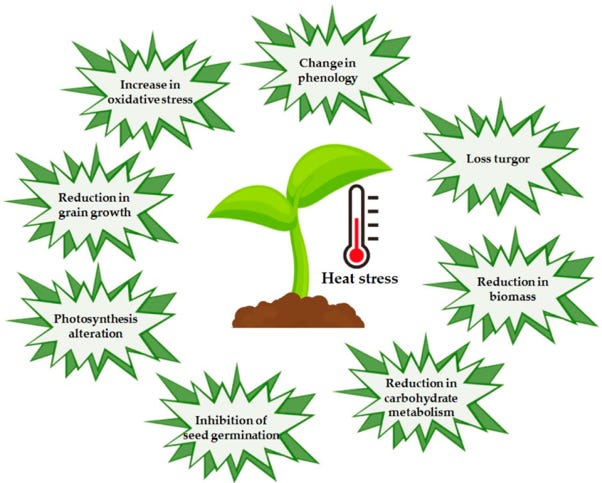
Effects of heat stress on plants (Image credit: https://doi.org/10.3390/stresses2010009)
Growth and crop yields slow: photosynthesis declines while respiration continues, an imbalance that can reduce a plant’s energy reserves over time.
Prolonged heat can also increase water loss through leaves and soil, leading to wilting and, in severe cases, leaf death.
Some short lived plants bolt and flower, hoping to set seed before they die (eg. lettuce). But most plants reduce or stop flowering during heatwaves, and existing blooms may drop off.
Leaves can curl, fold, and decrease their area, becoming thinned to avoid water loss by evapotranspiration.
Root systems and new aerial growth start to die back.
40+ C: extreme heat stress
For most plants (which use the C3 photosynthetic pathway) these temperatures are nearing the limits they can survive.
For these, heat scorch, death of new growth and death of whole plants ramp up as temperatures rise above 40 C. Younger plants are usually more vulnerable to damage and death.
Wheat and barley, for example are likely to suffer severe damage at 40 C and die at about 45 C. Fruit on apple trees will experience sunburn at 38 C and even with protectant clay-based sprays will suffer severe damage at 43 C.
A small group of plants use the C4 pathway and can tolerate higher temperatures without becoming so heat stressed. These include maize, pearl millet, sorghum, sugarcane, grain amaranths, most tropical pasture grasses, and miscanthus. Perhaps we should be growing amaranth instead of wheat?
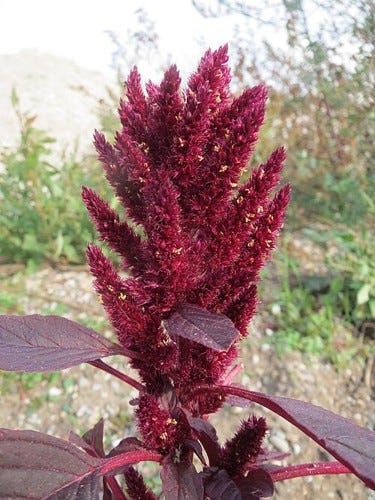
Amarathus cruentus, one of 3 species used as grain amaranths
How can we help our plants survive heatwaves?
Use agroforestry systems. The shade from higher trees and shrubs will reduce heat stress effects on lower plants. In addition, the hydraulic lift effect by trees means that the soil will dry out more slowly in the root zones of trees. Forest garden / food forest systems, once established, tend to be resilient in heatwaves, with temperatures under the canopy several degrees cooler (as it is in woodlands).
Increase soil organic matter and therefore the water-holding capacity of the soil. Tree-based systems will do this anyway, but you can also use woodchip mulches, any organic matter etc.
Don’t prune back apparently newly dead growth in summer, but wait until the following spring, as there may still be live buds on some growth.
If you have to irrigate, do so less often but making sure the water percolates deep. Use a tensiometer to check moisture levels deep down.
Grow more plants from lower latitudes
Give plants from higher latitudes (including native plants) some shade in summer by interplanting taller trees and shrubs with thin canopies to the south and west of susceptible plants. Highest daytime temperatures tend to be through the afternoon, so that protection from morning sun is less critical.
Grow plants in appropriate locations! Obvious really, but if it’s a woodland plant then grow it in a shady spot. Ferns are a good example, being very susceptible to heat damage. Other plants often grown in sun that really do need shade in a heatwave include Fuchsias and Magnolias.
For shade trees and large shrubs, choose species with smaller compound leaves as these get less heat stressed than trees with larger single leaves, and also tend to have fairly thin canopies which let some light through. Legumes are particularly good in this respect. Think Acacia, Albizia, Caragana, Colutea, Gleditsia, Gymnocladus, Laburnum, Maackia, Robinia, Sophora.
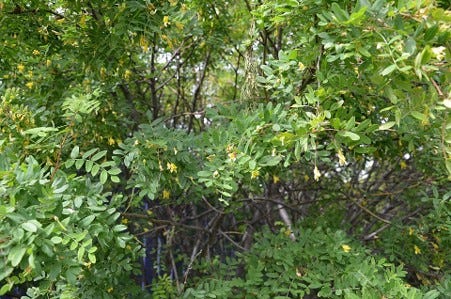
Gleditsia triacanthos
Just like humans, most plants are going to need some shade just to survive in future summer heatwaves. Tree-based growing systems are not just desirable but are going to be critical for our future.
Listen to my latest album High Pass on spotify here
Could it be time to re-evaluate the benefits for our climate, here in the UK, of incorporating biochar into the rhizosphere?
We've just been through the worst of the summer dry heat here in the Philippines. It didn't feel any worse than last years temperatures but I lost a few well established 4-7 year old trees, some natives, which I thought would be bearing the brunt of it.
The veggie beds completely stopped for me (but I'm not a very good gardener so it's not saying much) and an organic market gardener nearby said that despite watering (trickle irrigation I think) morning and afternoon their yields were significantly down.
Another local fruit farmer was telling me that despite watering their trees about 50L every 3 days (which blew my mind since that's a crazy amount) they were still losing them to the heat.
It's getting harder and harder to get new seedlings started unless you have the time to babysit them throughout the year.